Visuals
The redeveloped complex
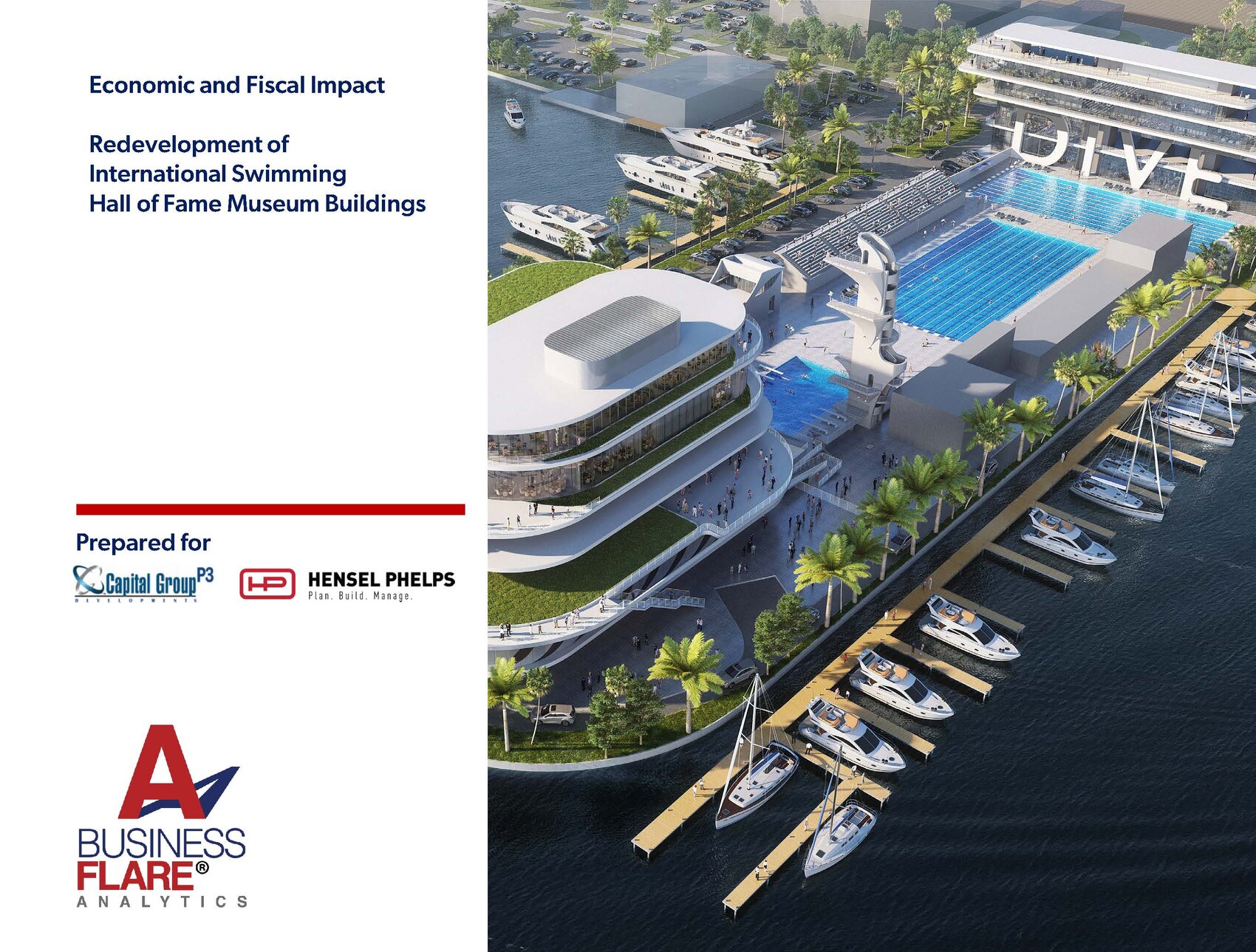
An economic and fiscal impact assessment of the redevelopment of Fort Lauderdale's International Swimming Hall of Fame — quantifying the construction lift, the recurring operations footprint, and the property- and sales-tax benefits the project returns to the community.
The International Swimming Hall of Fame occupies one of Fort Lauderdale's signature waterfront sites, pairing the City's public aquatic assets with a redeveloped museum, family aquarium, event and exhibit space, rooftop dining, and a public promenade along the water. BusinessFlare® was engaged by Capital Group and Hensel Phelps to quantify what the redevelopment delivers to the community — the one-time economic lift of construction, the recurring jobs and activity of daily operations, and the predictable property- and sales-tax benefits generated once the taxable buildings open.
The assessment separates the public realm — the aquatic center, promenade, dock, and Ocean Rescue facilities — from the taxable, income-producing buildings that anchor recurring fiscal benefits. Using the Broward County regional input-output structure and the project's own construction budget and operating plan, the analysis translates a roughly $219 million capital program into measurable output, employment, and tax revenue.
A $218.8 million construction program expands to $393.9 million in total regional economic output and supports 3,283 construction job-years during the buildout. Once open, the taxable buildings support roughly 312 recurring jobs and $29.35 million in annual economic output, and over 30 years are estimated to generate about $12.9 million in cumulative City property-tax receipts — approximately $54.5 million across City, County, Schools, and Hospital combined.
Four lenses on how the redevelopment creates value — during construction, in daily operations, and through recurring tax revenue.
Over roughly 30 months of active delivery, the construction budget converts into on-site payroll, purchase orders to Broward County vendors, and household spending — generating about $1.80 in local economic activity for every $1.00 of direct construction outlay.
Once both taxable buildings are open through a full calendar year, the project settles into a repeatable pattern of revenue, staffing, supplier orders, and household earnings — a hospitality-rich employment base that shows up in the neighborhood week after week.
The food-and-beverage and retail tenants generate taxable sales, estimated from the leasing schedule. State sales tax and the local discretionary surtax apply, producing recurring annual flows to the state and county.
The taxable buildings enter the tax roll on a cost basis after certificates of occupancy, then shift to a stabilized income-based assessment — producing a method-sound, predictable revenue line for the City and its overlapping jurisdictions.